Peter Groom
Introduction
I have been fortunate to have worked at the marvellous Kierikki Stone Age Centre, in northern Finland on several occasions and have been involved in experimental archaeology, experiential archaeology, traditional crafts, as well as building a skin-on-frame canoe, and a log boat.
This article documents the building of a skin-on-frame craft based on a British coracle.
Lightweight watercraft have a long global history, with examples from North and South America, Europe, northern Russia, Africa, and Asia (Hornell, 1946). In the British Isles, skin-boats were common and known by various names: curach in Scotland (Maclennan, 1995), currach or curragh in Ireland (Allen, 1993), cwrwgl and corwgl in Wales (Hornell, 1946; Evans & Thomas, 1976), and coracle in England (Hornell, 1946; Seymour, 2001).
Although designs varied according to local waters (Hornell, 1946; Seymour, 2001), traditional British skin-boats were typically flat-bottomed, frame-and-hide constructions. This principle guided the project approach which aimed to create a functional coracle using locally available materials and traditional techniques, in a way replicating ancient strategies.
Materials
The materials used reflected those available locally:
- Plant materials: Alder (Alnus sp.) and willow (Salix sp.)
- Skin: Elk (Alces alces)
- Cordage: Elk rawhide for lashings
- Tools: Time constraints meant that we used steel knives, a steel awl, and a pruning saw, rather than creating stone or bone tools. The task was to build the coracle.
Method
No formal plan was adopted; instead, the size and shape of the coracle were dictated by available resources, as would be the case for example, for a foraging Stone Age hunter-gatherer. This organic approach encouraged creativity and authenticity—no kits, pre-cut timber, or pre-prepared skins were used.
Resource Procurement
All basketry frame materials were harvested by hand from the Kierikki site. Willow was scarce, so alder provided most of the frame.
Specifications
Rods of 3-4m long and 2cm width were required, while the weavers were 1-2m long and 1cm width. It was key that these rods and weavers were consistent in form, so that the frame was as tight and smooth as possible, and less likely to pierce the skin. The bark was left on all the alder but removed from the willow for aesthetic purposes.
Materials, Tools, and Time Summary
| Item | Quantity / Dimensions | Purpose | Time Required |
|---|---|---|---|
| Alder rods | 14 rods, 3–4 m long, ~2 cm thick | Main frame structure | Harvesting & shaping: ~1 day |
| Alder & willow weavers | ~80 pieces, 1–2 m long, ~1 cm thick | Basketry weave for strength | Weaving: ~1 day |
| Stripped willow rods | Several short sections | Lateral strength, seat & footboard | Incorporated during weaving |
| Elk skin | 1 whole skin | Coracle covering | Skin prep: ~1 day |
| Elk rawhide strips | ~10 m total (1–3 cm wide) | Lashings and lacing | Ongoing during build |
| Tools | Steel hand-knives, steel awl, pruning saw | Cutting, shaping, piercing | Used throughout |
| Additional components | Flexible seat & footboard (willow rods) | Comfort and paddler support | Added after main assembly |
Overall build time:
- Frame construction: ~3 days (2 people)
- Skin preparation: ~1 day (1 person)
- Skin lacing: ~1 day (2 people)
Frame Construction
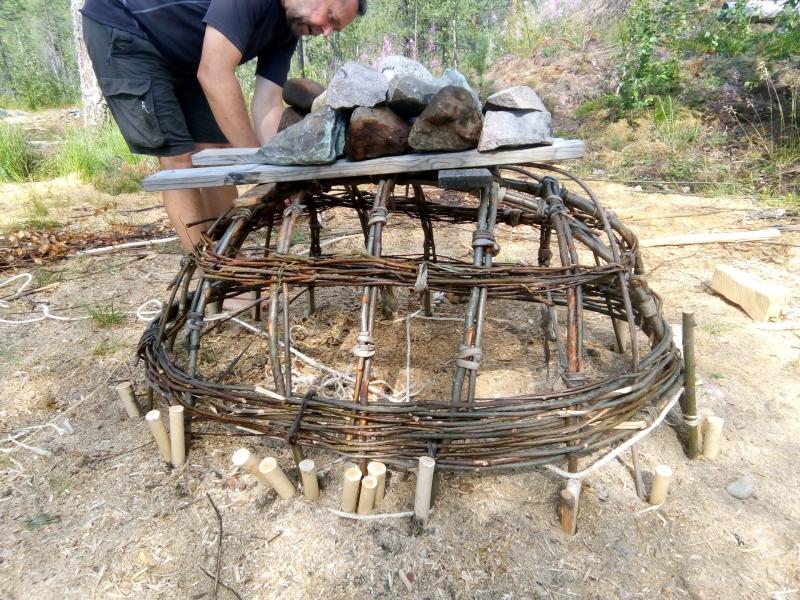
An unworked elk skin was laid on the ground, two long alder rods were placed on this and shaped and tied into an oval, taking care to gauge the potential size of the coracle frame and accounting for the curves and bottom. This alder hoop was then laid on the ground in the work area, ensuring that one end of the oval had a flatter profile. This would be the fore end (front). Using the damp sandy ground as a clamp, the butts of 14 alder rods were pushed into the ground at regular intervals around the outer edge of the hoop. The butts were tied to short pegs to prevent the rods from moving during the later weaving process, which would place tension on the frame. These rods were then bent over and tied to create the ribs (hoops) of an upside down ‘basket’ (Figure 1).
After all the rods had been bent and tied to the opposite rod with strips of elk rawhide, whippy alder weavers were used in a pairing weave to create two sections of strong basketry weave. Rather than weaving a complete basket frame, just two sections were completed: one at the gunwale (top) and one near the draft (base). The reason being that a complete weave increases the weight of the coracle, whereas this approach created strong areas where they were most needed but limited the overall weight. In this way, the coracle could be easily carried and handled by one person. The total amount of weavers was circa 80.
Throughout this process, rocks were used to weight the base of the coracle; otherwise, the tensions that developed in the frame during weaving could push the base upwards creating a keel, which was not a feature of traditional coracles (Hornell 1946).
When the weaving was complete, the port (left) and starboard (right) sides of the coracle were tied together with rawhide strips to prevent the sides from falling out. Stripped willow rods were added at this point, which added lateral strength and provided a colour contrast. Thwarts (bracing rods) made of alder were then attached at two points to prevent the coracle sides collapsing in.
Skin Preparation and Attachment
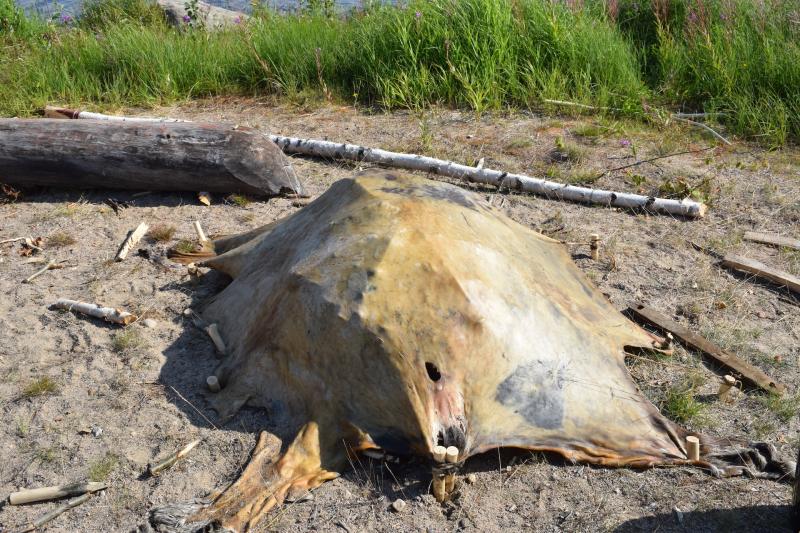
During the construction of the frame, the elk skin had been left to soak in the shallow water of the lake margin to soften the skin membrane and loosen the hairs. Warm water temperatures meant that the skin was ready for working after five days, after which the flesh, membrane and hair were removed easily. Once this rawhide was finished, it was again immersed overnight in the lake margin to regain flexibility. The following morning the now flexible hide was stretched, as tightly as possible over the coracle frame to allow for shrinkage on drying and pegged into the ground (Figure 2). This enabled the hide to semi-dry to shape, making the following procedure easier. Due to the lightweight nature of the coracle, it was easy to work and meant that one section of gunwale could be laced at a time, while the opposite gunwale and hide could be submerged in the lake, retaining moisture and flexibility. The hide was pulled over the gunwale and secured in place using rawhide lacing, using an awl to make the lace holes. No treatment, such as tar, was added to the hide.
Overall, approximately 10 metres of rawhide strips were used, ranging from 1cm width for the lacing, to 3cm width for the stronger lashings.
Final Adjustments
A flexible footboard and seat were added, made from willow rods lashed with rawhide, allowing adjustment for paddler comfort (Figure 3).
Trial
When trialled in a strong headwind through choppy water by a seasoned canoeist using the typical figure-of-eight paddle motion, the craft sat high in the water providing plenty of freeboard to protect the paddler and was very steady, proving to be lightweight, manoeuvrable, easy to handle and effective (Figure 4).
Conclusion
This project demonstrated the practicality and adaptability of constructing a skin-on-frame coracle using locally available materials and minimal tools. By foregoing a predetermined design and relying on resources from the surrounding environment, the process highlighted the ingenuity required in ancient and traditional watercraft manufacture. All plant materials were harvested on-site and used fresh, with only minor modifications for aesthetic purposes. The significant quantity of rawhide needed for lashings underscored the critical role of cordage in prehistoric technologies.
The project also emphasized the importance of working in harmony with natural materials—observing how they respond to bending, drying, and rehydration—and using these properties to shape and strengthen the craft. Despite the simplicity of the approach, the resulting coracle proved highly effective: lightweight, stable, and easy to handle. Ultimately, this project illustrates how a functional watercraft can be produced from just 14 alder rods, ~80 weavers, 10 metres of rawhide lashing, and a single elk skin, reaffirming the resourcefulness of ancient and traditional boat-building techniques.
References
Allen, R. E. (1993). The concise Oxford dictionary of current English. Oxford University Press.
Evans, H. M., & Thomas, W. O. (1976). Y Geiriadur Mawr: The complete Welsh-English dictionary. Salesbury Press Limited.
Hornell, J. (1946). Water Transport: Origins and Early Evolution. Cambridge University Press.
Maclennan, M. (1995). A pronouncing and etymological dictionary of the Gaelic language. Acair and Mercat Press.
Seymour, J. (2001). The forgotten arts and crafts. Dorling Kindersley.